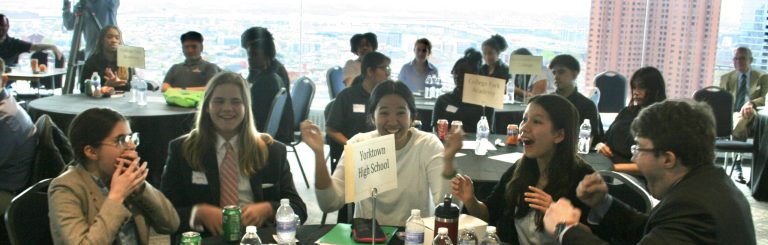
To find out more about the fun and excitement of Academic WorldQuest, click below to register your school!

DATE: April 22, 2026
TIME: 6:00pm, with a reception at 5:15
LOCATION: St. Mary's Seminary & University
and Zoom
How is life expressed in the midst of repression in China? What is the future of the economic powerhouse? What is the trajectory of U.S. China relations? Join the Council for what's guaranteed to be an intriguing and insightful presentation from Emily Feng, NPR reporter on Taiwan and China and author of "Let Only Red Flowers Bloom," a book that describes life in China through real people's experiences. She will discuss her book, the future of U.S.-China relations, where she thinks China is heading and event the world competition in semiconductors.
Read more and register here.

DATE: April 7, 2026
TIME: 6:00pm, with a reception at 5:15
LOCATION: St. Mary's Seminary & University
and Zoom
On April 7, David Ignatius will join the Council to discuss U.S. foreign policy efforts in the Middle East conflict and elsewhere. His recent columns set the stage for a discussion about current issues and calamities: the mistake of relying on decapitation as a tool of regime change; how Europe is pulling together in response to Putin’s campaign of sabotage; and Ukraine’s plans for keeping Russia at bay. BCFA members and non-members are invited to attend this event and gain expert insight into the frontline of U.S. foreign affairs.
Read more and register
The Baltimore Council on Foreign Affairs is dedicated to citizen education in foreign affairs. Membership is open to the public, with both individual and corporate plans available.


Current events through BCFA speakers and blogs
Gain exclusive access to our diverse range of programs, including in-person and virtual events, featuring prominent speakers and experts in international affairs.
Join our Leadership Dinners, where you can engage with guest speakers and other members in a more intimate setting, fostering deeper discussions and networking opportunities.
Contribute to and benefit from our educational programs aimed at enhancing understanding of international affairs among students and educators in the Baltimore region.
Expand your professional and social network by connecting with other members who share an interest in global issues, as well as with leading experts in the field.
Take advantage of member-specific benefits, such as guaranteed reservations for all programs, discounted event fees for guests, and access to additional resources and materials.
Join a community of individuals passionate about international affairs, and participate in discussions, volunteer opportunities, and initiatives that make a difference locally and globally.
Be the First to Hear about Upcoming Speakers
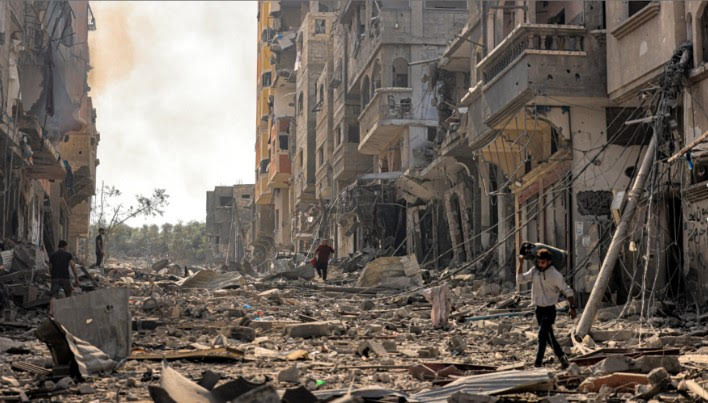
Forced displacement represents one of the most pressing humanitarian issues of our time. Individuals and families, torn from the fabric of their communities, find themselves navigating a world of uncertainty, often without basic necessities or a clear path to safety. There are currently some 110 million forced displaced, and this number is growing by 10 million each year!
At the heart of this crisis are the political triggers. Armed conflicts, ethnic or religious persecutions, and systemic human rights abuses force millions to flee their homes in terror. Many are displaced within their own national boundaries, while others seek asylum abroad. If these factors change as a result of political shifts at home or the pressures from abroad, they can return to their homes. Forced displacement is thus different from environmentally driven displacement, as victims of climate change may never be able to return to their homes.
The ramifications of any sort of displacement are profound, not just for those directly affected, but also for host communities and countries. Overburdened infrastructures, socio-economic strains, and cultural tensions can arise, necessitating comprehensive strategies to foster harmony and integration. Yet the root causes of forced displacement can be remedied with a concerted focus by local players and international diplomacy.
Organizations like Refugees International play a crucial role in this arena, advocating for the rights and needs of the displaced, conducting on-the-ground assessments, and influencing policymakers to take informed actions. Their relentless work underscores the gravity of the situation and the urgency ofinternational cooperation. But they, too, are overwhelmed by the rapid expansion of the crisis.
International Humanitarian Law (IHL), with its core principles centered on the protection of civilians during conflicts, plays a pivotal role in this discourse. Yet, despite clear legal frameworks, compliance remains
inconsistent. This initiative emphasizes the importance of upholding and reinforcing these international standards.
It’s not just about recognizing the problem; it’s about active engagement. We urge governments, organizations, and individuals to prioritize the rights and needs of the forced displaced. Through collective efforts, informed policies, and sustained advocacy, we can shift the narrative from passive acknowledgment to proactive intervention.